

UAE Moves Forward with E-Invoicing
The UAE Ministry of Finance (MoF) has announced a series of strategic transformation initiatives, including the development of a federal-level invoicing system called the Electronic Invoicing System (e-invoicing).
This change marks a shift from traditional invoicing methods such as paper invoices, PDF attachments, and manual VAT reconciliations. These will be replaced by a digital system that connects businesses directly with the Ministry of Finance (MoF) and Federal Tax Authority (FTA).
To support this transition, the MoF issued Federal Decree-Law No. 16 of 2024 on 30 September 2024, updating the UAE VAT Law to create a legal framework for e-invoicing. The law officially recognizes electronic invoices as valid for issuing and claiming input tax, effective 1 November 2024. At the same time, Federal Decree-Law No. 17 of 2024 introduced changes to the tax procedures law to align with the e-invoicing.
Following this, the MoF issued Ministerial Decision No. 64 of 2025, which sets out the criteria and procedures for accrediting service providers involved in the e-invoicing system. Further guidance was introduced through Ministerial Decisions No. 243 and 244 of 2025, which define the scope, implementation (voluntary and mandatory) timeline, taxpayer obligations, and exclusion. These decisions also outline a pilot programme for early participants.
The UAE’s e-invoicing system is based on the Peppol standard, which allows businesses to issue and receive invoices in a structured digital format. The system includes real-time validation to ensure accuracy and consistency.
Under this framework, the Ministry of Finance is responsible for governance and for accrediting service providers. The Federal Tax Authority (FTA) is responsible for compliance and enforcement. The e-invoicing system is designed to improve tax processes and support the digital transformation of business operations in the UAE.
What is E-invoicing?
E-invoicing, or electronic invoicing, refers to the process of issuing, receiving, and storing invoices in a structured digital format rather than using paper or PDF files. It allows for direct and automated exchange of invoice data between businesses and, in many cases, with tax authorities. E-invoicing helps reduce manual work, improves accuracy, and supports compliance with tax regulations. In the UAE and many other countries, it is being adopted as part of broader efforts to enhance the efficiency and transparency of tax systems.
Overview of the UAE e-invoicing Model: Decentralized Continuous Transaction Control and Exchange (DCTCE) / 5 corner model
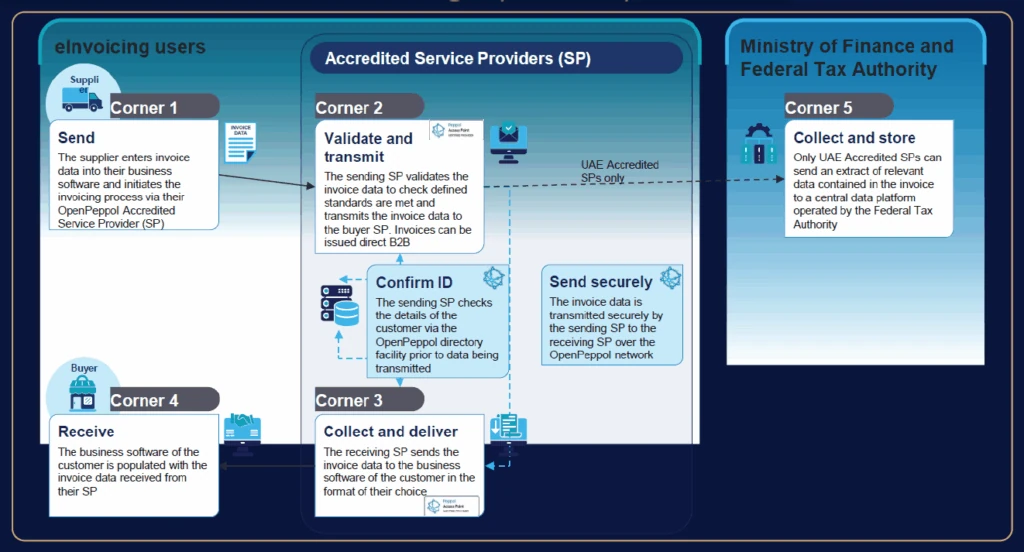
E-invoicing Structure: The UAE e-invoicing framework consists of five components (referred to as “corners”) that define the roles of suppliers, buyers, service providers, and authorities (MoF and FTA).
Applicability: E-invoicing applies to all persons conducting business in the UAE for every business transaction, except for those excluded under Article 4 of Ministerial Decision No. 243 of 2025 and business-to-consumer (B2C) transactions as outlined in Article 5 of Ministerial Decision No. 244 of 2025.
Invoice Flow (B2B or B2G): For business-to-business/Government transactions, the supplier issues the e-invoice through an Accredited Service Provider (ASP). The buyer receives the invoice via their own ASP. At the same time, both the Ministry of Finance (MoF) and the Federal Tax Authority (FTA) also receive the invoice.
VAT Groups: In cases involving a VAT group, each group member must have its own endpoint through a UAE-accredited service provider. While invoices should include the VAT group’s TRN, the endpoint must correspond to the specific group member responsible for the transaction.
Exports and Foreign Buyers: If the foreign buyer is registered on the Peppol network, their endpoint must be used. If the buyer is not registered, a dummy endpoint will be applied. In such cases, the invoice is not transmitted via Peppol, but the seller’s ASP (Corner 2) still reports the invoice to MoF/FTA (Corner 5). The seller is required to send the invoice to the buyer through external means (e.g., email). Registration with a UAE-accredited service provider is not required for overseas buyers unless specifically required under UAE VAT or Corporate Tax laws.
Self-billing: In self-billing scenarios, the buyer generates the e-invoice, sends it to the supplier, and submits it to the FTA through an accredited service provider.
Transaction Scope: The e-invoicing framework covers all B2B (business-to-business) and B2G (business-to-government) transactions, regardless of whether the entities involved are VAT-registered or not.
Key Takeaways from Ministerial Decisions No. 243 and 244 of 2025:
As previously mentioned, Ministerial Decisions 243 and 244 of 2025 lay the foundation for a structured, phased rollout of the UAE’s Electronic Invoicing System, marking a significant step in the country’s digital transformation and tax modernization journey. Ministerial Decision 243 of 2025 clarifies who must comply, the scope, and key exclusions, while Ministerial Decision 244 defines the implementation phases, timelines, and compliance obligations for businesses of all sizes and government entities. Together, these decisions provide a clear roadmap for businesses to prepare, adopt, and transition smoothly to a transparent, efficient, and real-time invoicing system. Early preparation will help businesses not only stay compliant but also benefit from automation, accuracy, and improved operational efficiency as the UAE moves toward a fully digital tax ecosystem.
Ministerial Decision No. 243 of 2025 — Scope, Exclusion and Appointment of Accredited
Service Provider and the other Obligations
Decision clarifies who falls under the e-Invoicing framework and outlines exclusions.
Scope:
Applies to all persons conducting business in the UAE, including VAT-registered and non-registered entities engaged in business transactions other than the below exclusions.
Exclusions:
- Government entities perform sovereign functions (not competing commercially).
- International passenger transportation services provided by an Airline via an Aircraft, where an Electronic Ticket is issued to the passengers.
- Any services provided directly to the passengers by an Airline, that are ancillary to the services mentioned above, where an Electronic Miscellaneous Document is issued for such services.
- International transportation services in respect of goods, provided by an Airline, where an Airway Bill is issued for such services, provided that this exclusion shall apply only for a period of twenty-four (24) months from the date on which the Electronic Invoicing System becomes effective.
- Financial services exempt or zero-rated under VAT law.
- Any other Business Transaction as may be determined by the Minister.
Compliance & Technical Requirements
- Businesses are required to connect with an Accredited Service Provider (ASP), certified
by the MoF. - The Businesses shall notify the appointed Accredited Service Provider in writing of any change to the data registered with the Authority, within five (5) Business Days from receiving confirmation of the amendment by the Authority.
- Businesses shall issue and transmit an Electronic Invoice to the Recipient in respect of
any Business Transaction. - The Electronic Invoice or Electronic Credit Note must be issued and transmitted by the
Issuer through the Electronic Invoicing System within 14 days from the Date of Business
Transaction. - The business shall issue and transmit an Electronic Credit Note to the Recipient in the
following cases:
>Where the Business Transaction is cancelled.
>Where the agreed consideration for the Business Transaction is reduced forany reason.
>Where the consideration for the Business Transaction is returned in full or in part.
>Where an administrative or numerical error has occurred in relation to the Business Transaction.
- The Authority shall have the power to access and use any data processed, received and
stored under the Electronic Invoicing System.
Ministerial Decision No. 244 of 2025 – Phased Implementation of UAE E-Invoicing
Scope of Application
The e-invoicing system applies to:
- All businesses conducting commercial transactions in the UAE, including non-resident
entities - Voluntary adopters who wish to implement the system ahead of schedule
- Any other entities designated by the Ministry
Pilot Program and Phased Rollout
- Pilot Programme is a programme under which the Ministry and the Authority will
establish a Taxpayer Working Group to be part of a pilot for the purposes of testing and
implementing the Electronic Invoicing System under the supervision of the Ministry, in
accordance with this Decision - The implementation begins with a Pilot Programme launching on 1 July 2026, involving a Taxpayer Working Group selected by the Ministry. Participation is voluntary and requires written consent. These entities will help test the system under the supervision of the MoF and the Federal Tax Authority.
Voluntary Implementation
Any Person may implement the Electronic Invoicing System on a voluntary basis as from
1 July 2026 and shall, in that case, comply with all the technical requirements established by the Ministry and the Authority for the use of the Electronic Invoicing System.
Mandatory Implementation
1. Large Businesses (Revenue ≥ AED 50 million)
- Must appoint an Accredited Service Provider (ASP) by 31 July 2026.
- Must implement the Electronic Invoicing System by 1 January 2027.
2. Smaller Businesses (Revenue<AED 50 million)
- Must appoint an ASP by 31 March 2027.
- Must implement the system by 1 July 2027.
3. Government Entities
- Must appoint an ASP by 31 March 2027.
- Must implement the system by 1 October 2027.
4. All other businesses and government entities
- After the above phases are completed, any remaining entities subject to the system
must appoint an ASP and implement the Electronic Invoicing System.
Business-to-Customer (B2C) transactions
B2C transactions shall not be subject to the e-invoicing system and any person engaged exclusively in such transactions shall not be subject to the e-invoicing system, until such time determined by a decision issued by the minister.
How BAM Can Help
Readiness Assessment – Evaluate if your business falls within the scope of the UAE
e-Invoicing system and identify gaps.
System & ASP Advisory – Guide the selection and onboarding of an Accredited Service
Provider (ASP) and ensure your ERP or invoicing systems are compliant.
Coordinate with ASP – Ongoing support to maintain communication with the ASP and to relay any updates or changes required within the e-invoicing mechanism.
Gap analysis – Review the existing internal control system and ERP or accounting software to assess its readiness for e-invoicing and recommend necessary changes to ensure
alignment with the e-invoicing framework.
Implementation Support – Assist with configuring, testing, and deploying the e-Invoicing
system across all business units.
Training & Compliance – Train finance and IT teams on e-Invoicing processes and ensure ongoing adherence to MoF and FTA requirements.