
Maximize your business potential with professional Corporate Tax Advisory services from BAM Advisors. We understand that every business is unique, which is why our advice is customized to meet your specific needs. Our comprehensive approach includes analyzing your current tax structure, identifying opportunities for savings, and implementing solutions that support your growth objectives. Whether you’re expanding business operations, restructuring, or facing new regulatory changes, we stay up to date with the latest tax laws to provide proactive guidance.
Small Business Relief can be elected by Resident Persons, including both natural persons and juridical (legal) persons, who are eligible to opt for the Small Business Relief. The conditions for Small Business Relief are as below:
- The election must be made for each individual tax period.
- The business’s revenue must be AED 3,000,000 (Three Million) or less in the current tax period and in previous tax periods.
If the above conditions are met:
- The business will be treated as if it did not derive any taxable income in the tax period.
- Other exemptions, reliefs, and deductions are not available under this election.
- While transfer pricing documentation is not required upon election, the business must still comply with the arm’s length principle.
At BAM Advisors, we provide guidance to small businesses with simplified tax treatment, reducing compliance burdens, and fostering growth within the SME sector in the UAE.
Under the UAE Corporate Tax Law, a tax group refers to a special arrangement where two or more resident companies can form a single taxable entity, subject to the conditions outlined in the law. This mechanism offers potential benefits for group companies, such as simplified tax compliance and consolidated tax reporting. However, it also comes with certain limitations and considerations that need careful evaluation for optimizing your tax strategy and ensuring compliance with regulations.
UAE group entities may elect to form a tax group, provided all of the following conditions are satisfied:
- The parent company must be a UAE tax resident and can be a foreign legal entity having POEM (Place of Effective Management) in the United Arab Emirates where all key management and commercial decision are made to conduct the business of the entity and should own at least 95% of the ownership interest in the form of shares capital, voting rights and entitlement to profits and net assets.
- The Group’s Parent company and their subsidiary companies must have the same financial year and prepare the financial statements using the same accounting standards.
- Neither the parent company nor the subsidiary is an exempt person or a Qualifying Free Zone Person (QFZP).
The United Arab Emirates (UAE) introduced a federal corporate tax framework, effective from June 1, 2023, marking a major transformation in the country's tax landscape. The standard corporate tax rate is set at 9% on taxable profits exceeding AED 375,000, while certain categories of income are exempt under the UAE Corporate Tax Law.
Exempt income pertains to certain types of income (earnings) that are excluded from the corporate tax base, meaning no tax is payable on these amounts. The primary purpose of these exemptions is to prevent double taxation, promote investment, and maintain the UAE’s status as an attractive jurisdiction for both domestic and international businesses. These strategic provisions support the country’s ongoing economic growth and global competitiveness.
The categories of Exempt Income are mentioned below:
- Income from Foreign Permanent Establishments (PE)
- Income from Dividends or Profit Distribution received by the UAE taxable person.
- Income earned by a non-resident from operating aircraft or ships in international transportation.
- Income from Participating Interest (ownership interest of 5% or more)
To benefit from Exempt Income, certain conditions must be met under the UAE Corporate Tax Law. At BAM Advisors, we conduct a comprehensive assessment of your businessposition and provide expert guidance to help you effectively utilize these exemptions. Our team is dedicated to ensuring you maximize your tax efficiency while maintaining full compliance with the regulations.
The UAE offers one of the most competitive corporate tax rates in the world, making it an ideal location for business growth.
Currently, UAE corporate tax is levied on annual taxable income as follows:
0% for income up to AED 375,000, and 9% for taxable income exceeding AED 375,000.
There is also Domestic Minimum Top Up Tax (DMTT) at 15% on UAE entities of a large multinational enterprise (“MNE”) where global revenue is 750 Million Euros in two of the preceding 4 financial years.
Navigating these rates with expert guidance ensures compliance, maximizes tax efficiency, and supports your business’s financial health. Availing of corporate tax advisory services in UAE can help entrepreneurs understand the applicable tax rates based on their business model.
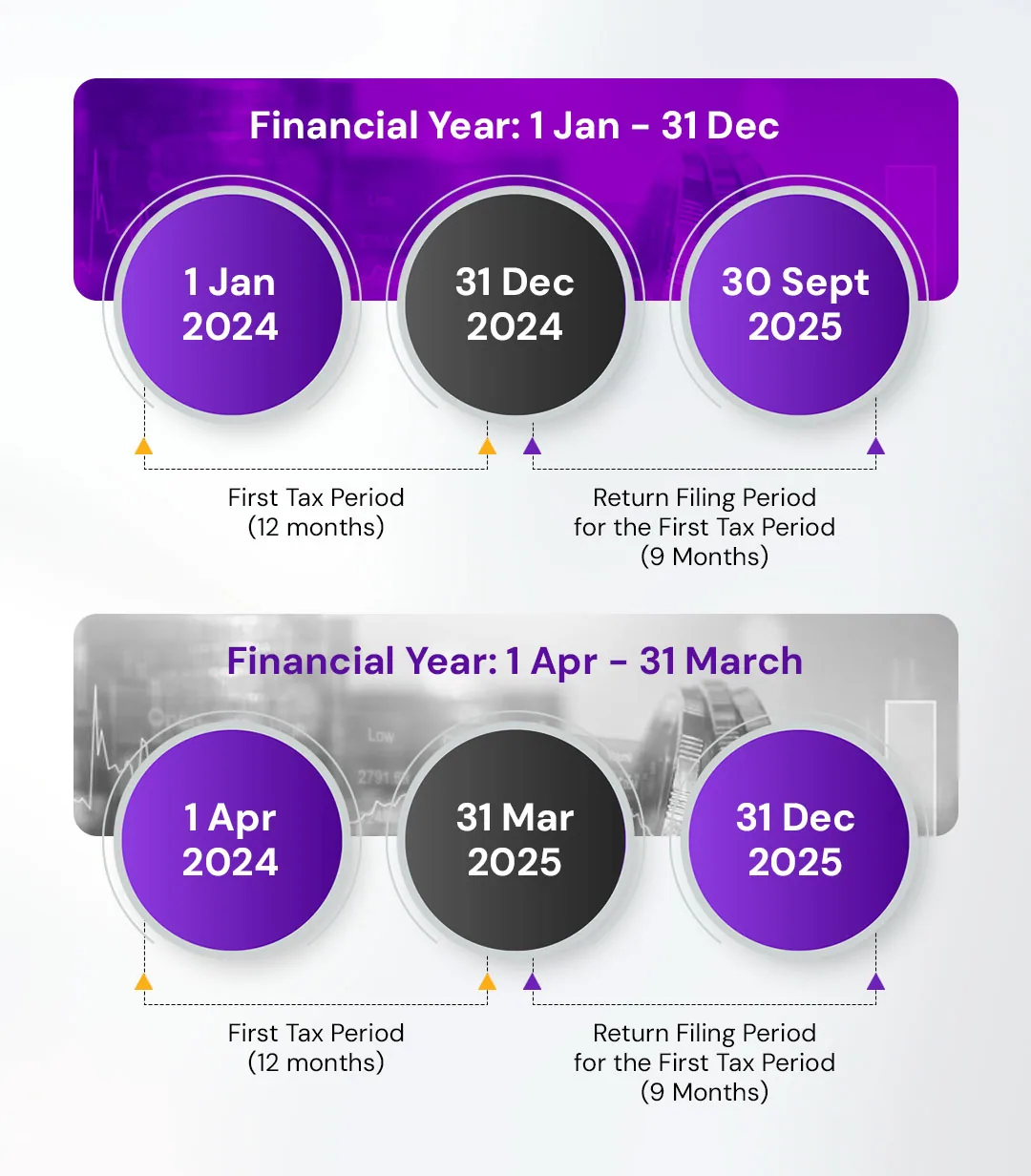
In the UAE, tax persons must strictly follow the Corporate Tax timeline to ensure timely compliance. This involves filing the tax return for each 12-month tax period within 9 months of the end of the relevant financial year. Along with the return, businesses are expected to maintain comprehensive financial statements that accurately reflect their financial position during that period. Adhering to these deadlines is crucial to avoid penalties and ensure that the business remains compliant with UAE tax regulations.
Each tax period, whether it aligns with the entire financial year or a specific portion of it, necessitates the need for submission of a tax return by the taxable person. In the UAE, the tax period is typically based on the Gregorian calendar year or the 12-month period for which financial statements are prepared. This structure ensures consistency in reporting and compliance, regardless of whether the tax period is the full year or part period.
When an entity identifies an error after submitting its tax return, a voluntary disclosure must be made. This disclosure should be submitted within 20 business days from the date the error is recognized to ensure compliance and avoid potential penalties.
If a business fails to file its corporate tax return by the timelines, penalties will be imposed. For the first 12 months of delay, a fine of AED 500 per month, or part thereof, will apply. If the delay exceeds 12 months, the penalty increases to AED 1,000 per month, or part thereof, until the return is properly filed.
The corporate tax liability must be paid in full by the deadline for filing the tax return. Failure to settle the payment on time will lead to monetary penalties imposed by the Federal Tax Authority as mentioned below:
- A monthly penalty of 14% per annum will be imposed on any unsettled payable tax amount, calculated for each month or part thereof, starting from the day after the original due date of payment. This penalty will accrue monthly thereafter until the amount is paid in full.
- For the purposes of this penalty, the due date of payment in the case of the Voluntary Disclosure and Tax Assessment shall be as follows:
- In the case of a Voluntary Disclosure, the due date is 20 business days from the date of submission.
- In the case of a Tax Assessment, the due date is 20 business days from the date of receipt of the assessment.
BAM Advisors can assist clients in ensuring compliance with the UAE Corporate Tax Law by providing expert guidance on timely filing of Corporate Tax Returns, managing accurate payments, and understanding penalties for non-filing, thereby helping them navigate the tax obligations efficiently and avoid costly penalties.