
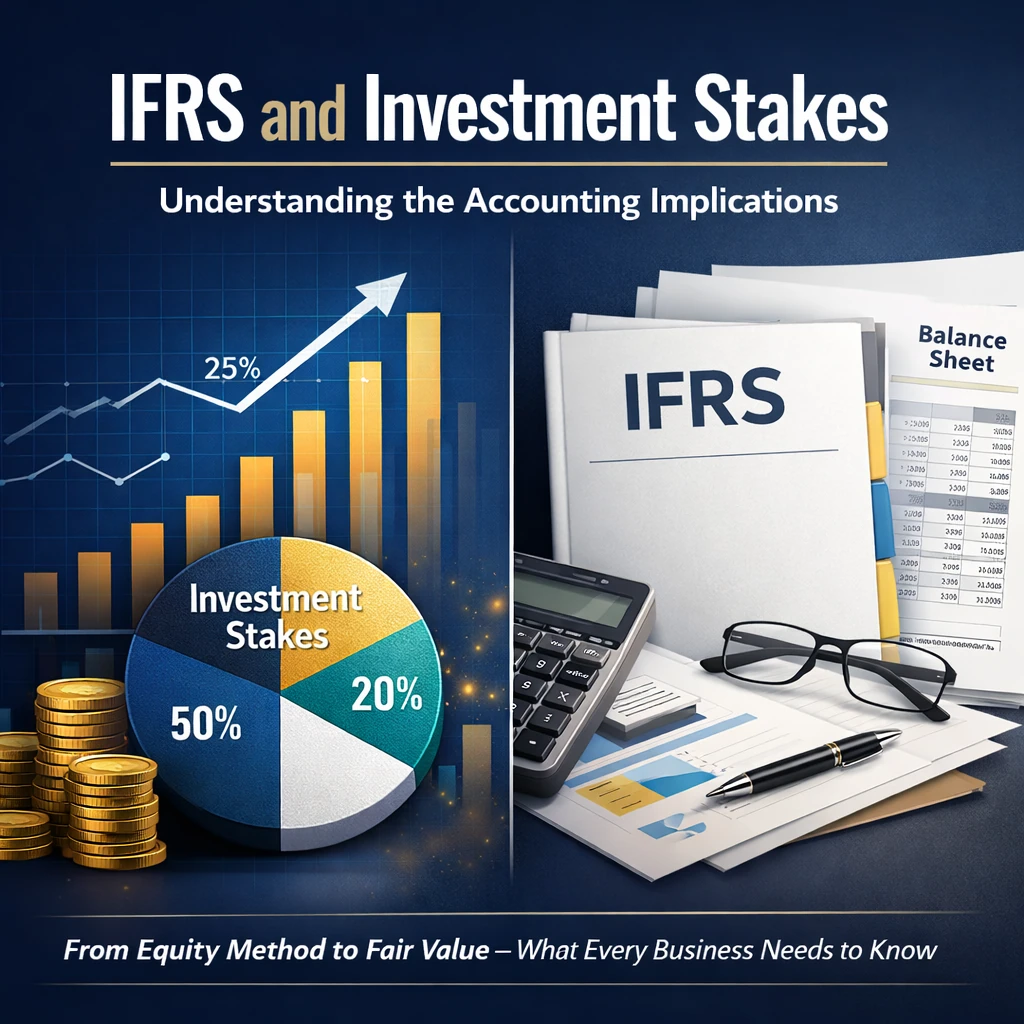
How IFRS accounting treatment for investment holdings varies based on the investor’s level of influence or control.
“Understanding how investment holdings are accounted for under International Financial Reporting Standards [IFRS] starts with one crucial factor: the level of influence or control an investor has over the investee. Whether the stake is small and passive or large enough to shape strategic decisions, IFRS assigns different measurement and reporting requirements that can significantly affect financial statements.
This article unpacks how stake levels drive these accounting treatments and why getting them right matters for transparency, comparability, and informed decision-making.”
- For passive investments with no significant influence or control, IFRS 9: Financial Instruments requires these to be treated as financial instruments, measured at either fair value or amortized cost.
- When an investor holds the power to participate in financial and operating policy decisions, generally presumed at a 20% to 50% voting interest, IAS 28: Investments in Associates and Joint Ventures mandates the use of the equity method.
- Shared governance is managed under IFRS 11: Joint Arrangements, which distinguishes between joint operations and joint ventures.
- Once an investor achieves control, defined by possessing power and exposure to variable returns, IFRS 10: Consolidated Financial Statements requires the parent to present the group as a single economic entity.
Accounting Implications
Passive Investment
IFRS 9 When an investor has no significant influence, joint control, or control, the investment is treated as a financial instrument. These are typically equity interests under 20% or debt instruments
Significant influence
IAS 28 Significant influence is the power to participate in financial and operating policy decisions but is not control. These are accounted for using the equity method
Sharing of control
IFRS 11 Joint control is the contractually agreed sharing of control, where decisions require unanimous consent. Arrangement can be a joint venture or a joint operation.
Control
IFRS 10 & IFRS 3 Control exists when the investor has power over the investee, exposure to variable returns, and the ability to use its power to affect those returns Parent must prepare consolidated financial statements, presenting the group as a single economic entity
How BAM can assist you
- Consolidation Services and Group Reporting
Prepare consolidated financial statements for parent companies, uniform accounting policy implementation, and non-controlling interest calculations.
- Separate Financial Statements Preparation
Prepare entity-level financial statements with appropriate investment accounting elections (cost, IFRS 9, or equity method).
- Equity Method Implementation and Ongoing Application
Establish and maintain equity method accounting for associates and joint ventures
- Step Acquisition and Disposal Transaction Advisory
Guidance on complex ownership transitions, deconsolidation accounting, and retained interest valuation..
- Investment Classification and Measurement Advisory
Assess the nature and extent of investor influence to determine appropriate accounting treatment under IFRS 9, IAS 28, IFRS 11, or IFRS 10, ensuring compliance with the correct financial reporting framework.
- Investment Portfolio Compliance and Technical Accounting Support
Provide ongoing technical guidance on complex investment accounting matters