
Why This Clarification Matters
The UAE Federal Tax Authority (FTA) has issued important public clarification-CTP010 on the interpretation of the terms “Director” and “Officer” under the Corporate Tax framework.
As per Article 36(1) of the Corporate Tax Law, a payment or benefit provided by a Taxable Person to its Connected Person shall be deductible only if and to the extent that the payment or benefit corresponds with the Market Value of the service rendered and is incurred wholly and exclusively for the purposes of the Taxable Person’s Business.
MEANING OF “DIRECTOR”
A Director is associated with individuals formally appointed to the board or any equivalent governing body.
A “director” is a person who is officially appointed to sit on a company’s board of directors. This can include executive, non-executive, temporary, permanent, or alternate directors, as well as members of any board committee. If a company does not have a board of directors, then a “director” means a person who is part of an equivalent governing body (such as a board of trustees or board of governors), as defined in the company’s legal documents such as memorandum / articles of association, partnership deed, trust deed or under applicable law.
Just having the word “director” in a job title does not automatically make someone a director for legal or tax purposes. If someone has the title “director” but is not actually appointed to the board or an equivalent governing body, they are not considered a director under the Corporate Tax Law
MEANING OF “OFFICERS”
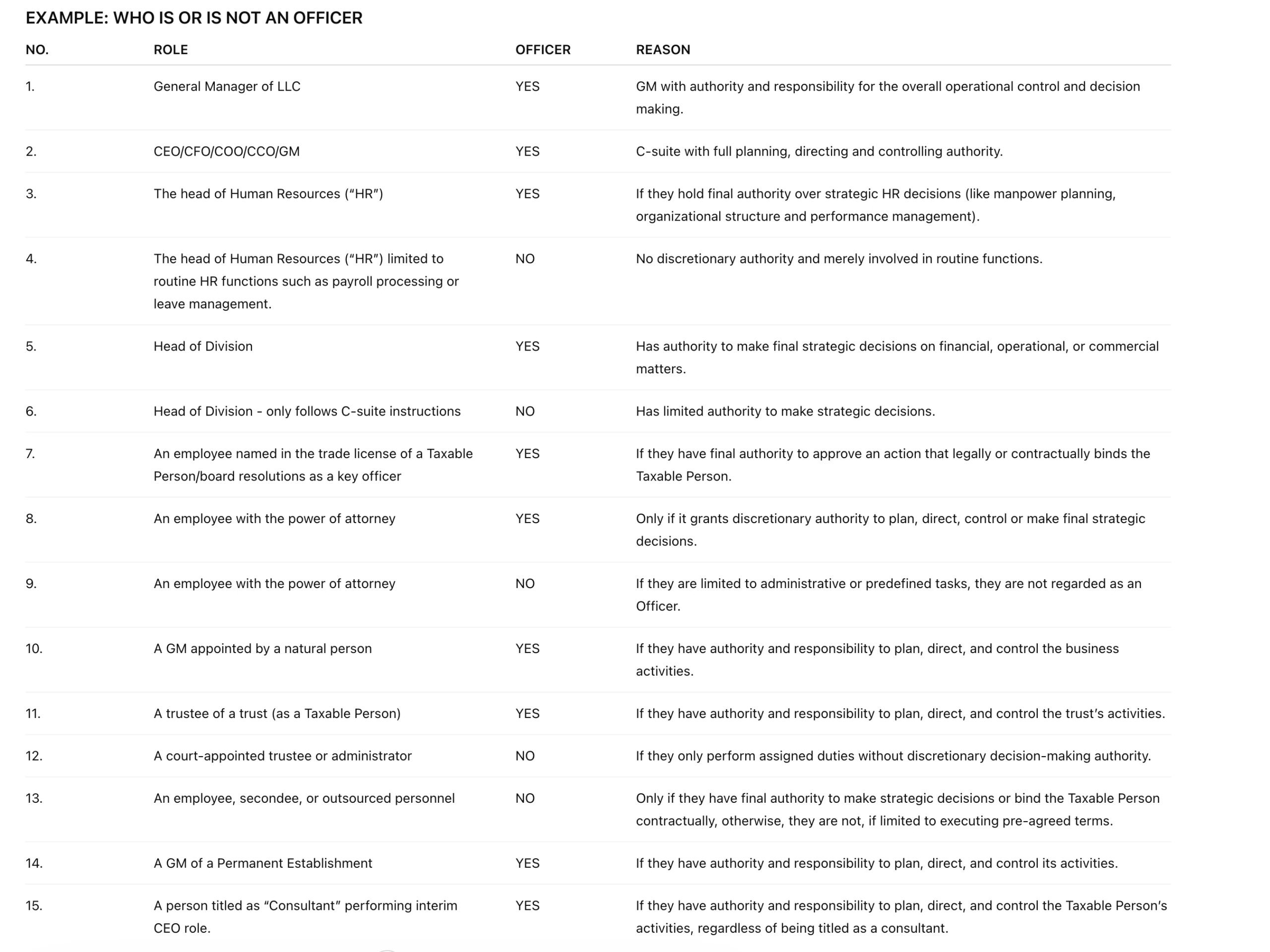
An Officer, on the other hand, refers to individuals in senior management positions who have final/ultimate strategics decision-making authority over business operations, finance, or strategy. An “officer” is a person who has real authority to manage or control the business activities of a taxable person.
An “officer” may include (but is not limited to) CEO, General Manager, CFO, COO, CCO, and authorized representatives with discretionary authority. A job title alone is not enough to decide if an individual is an officer. What matters is their actual authority and what they really perform with in the company. Even if an individual does not have an official title, they can still be considered an officer if they effectively make major decisions or control the business in practice.
This definition applies to all types of entities, including companies, trusts, foundations and partnerships.
An Officer includes any individual who can:
• Plan, direct, and control the taxable person’s activities (As per IAS 24).
• Make key strategic decisions (financial, operational or business related).
• Sign agreements or approve actions that legally bind the company.
Substance Over Form
The FTA emphasizes the principle of “substance over form” meaning that even where a person does not hold a formal appointment or a C-suite designation, they may still be treated as an “officer” based on their actual conduct, if they exercise authority and responsibility for planning, directing, and controlling the activities of the Taxable Person, or have the final/ultimate strategic decisions and or binding authority of Taxable Person.
How BAM Can Support You
Navigating the FTA’s latest clarification on Connected Persons goes beyond technical interpretation, it demands a practical, well-documented approach tailored to your business.
At BAM, we deliver end-to-end support that helps you stay compliant, defend your positions and reduce tax risk with confidence.
- 1. Identify who qualifies as Director / Officer:
We help you accurately identify all individuals who qualify as directors or officers based on substance over form, going beyond job titles to assess actual roles, authority, and responsibilities, ensuring complete identification and full alignment with FTA expectations.
- 2. Risk Assessment & Gap Analysis:
Our team performs a thorough review of your current organizational structure to identify any misclassifications or potential exposure areas, helping you proactively address risks related to non-compliance, disallowed expenses, or penalties before they escalate into penalties.
- 3. Review of Payments & Deductibility:
We assess all payments made to Connected Persons, including salaries, bonuses, and benefits, to ensure they meet market value requirements and remain fully deductible for corporate tax purposes, while highlighting and mitigating any potential tax risks.
- 4. Transfer Pricing & Benchmarking Support:
We provide robust benchmarking analysis and transfer pricing support to substantiate that compensation, and transactions are at arm’s length, strengthening your compliance position and ensuring alignment with both Connected Person and Related Party rules.
- 5. Connected Person vs Related Party Classification:
We carefully evaluate overlapping scenarios to ensure correct classification between Connected Persons and Related Parties, helping you apply the appropriate tax treatment and avoid duplication or incorrect compliance obligations.
- 6. Tax Return & Disclosure Support:
Our team supports you with accurate and complete disclosures in your corporate tax return,including aggregation of payments and threshold assessments,ensuring full compliance and minimizing the risk of penalties.
- 7. Policy & Documentation Framework:
Finally, we help you build a strong foundation through robust policy and documentation frameworks, covering remuneration, governance, and related-party transactions, so your position is well-defended in the event of an FTA assessment or audit.