
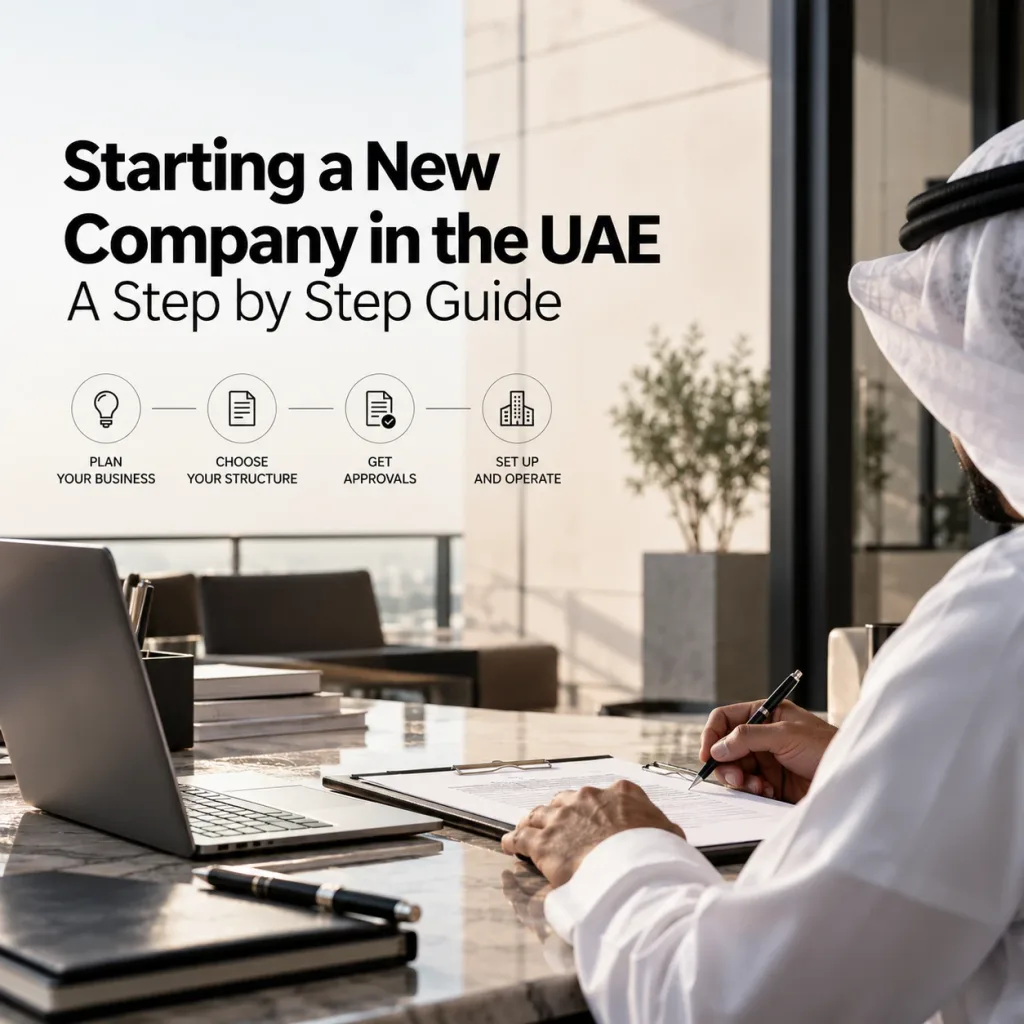
The UAE continues to be one of the most attractive destinations globally for starting a business -offering zero personal income tax, 100% foreign ownership in most sectors, and a strategic location connecting global markets.
However, while the opportunity is strong, setting up a company still requires careful planning and the right decisions. Here’s a practical step-by-step guide to help you navigate the process.
1. Choose Your Jurisdiction: Mainland, Free Zone, or Offshore
This is the most critical decision — everything else depends on it.
- Mainland: Licensed by the Department of Economic Development (DED) of each emirate. Allows you to trade anywhere in the UAE and work directly with local clients and government entities. Ideal for businesses targeting the UAE market.
- Free Zone: Over 50 free zones across the UAE offering 100% foreign ownership, tax benefits, and simplified setup. Best suited for consulting, trading, and international businesses. Recent regulatory updates have also made it easier for free zone companies to operate in the mainland under specific conditions.
- Offshore: Primarily used for holding companies or international structuring. These entities cannot conduct business within the UAE.
2. Define Your Business Activity and Legal Structure
Your license will only cover approved business activities, so selecting the right activity is essential.
You’ll also need to decide on your legal structure, such as:
- Limited Liability Company (LLC)
- Sole Establishment
- Branch of a Foreign Company
- Civil Company
Each structure has its own compliance requirements and ownership implications.
3. Reserve Your Trade Name & Obtain Initial Approval
Choose a unique trade name that complies with UAE naming regulations.
Once approved, you’ll receive initial approval — confirming that the authorities have no objection to your business setup.
4. Draft the Memorandum of Association (MOA)
For most company structures, especially LLCs, an MOA is required.
This document outlines:
- Shareholding structure
- Business activities
- Capital distribution
In mainland setups, the MOA is typically notarized, while free zones often provide standard templates.
5. Secure a Business Address
- Mainland companies must have a physical office space.
- Free zones offer flexible options such as flexi-desks or shared offices, helping reduce initial costs.
6. Submit license Application & Pay Fees
You will need to submit:
- Passport copies of shareholders
- Proof of address
- MOA and legal documents
- Business plan (if required)
Costs vary depending on jurisdiction, visa quota, and office requirements. Entry-level packages in Free zones can start with very low Authority fees.
7. Obtain Your Trade License
Once approved, you’ll receive your trade license — the official authorization to operate your business.
This is accompanied by an Establishment Card (especially in free zones), which is required for employment visa processing.
8. Open a Corporate Bank Account
With your license in place, you can apply for a business bank account.
Typical timelines:
- 3–4 weeks for established businesses
- 6–8 weeks for new entities (due to compliance checks)
Proper documentation and a clear business model significantly speed up approval.
9. Apply for Residency Visas
You can now sponsor:
- Investor/Partner visas
- Employee visas
- Dependent visas
The number of visas depends on your office space and license type.
10. Register for Corporate Tax & VAT
The UAE introduced Value Added Tax (VAT) effective January 2018 and Corporate Tax (CT) effective June 2023:
- 9% tax applies on profits above AED 375,000
- Free zone companies may benefit from 0% tax if they qualify
VAT registration is mandatory if your turnover exceeds the prescribed threshold of AED 375,000 (voluntary registration threshold is AED 187,500).
Key Considerations
- Mainland vs Free Zone trade restrictions are evolving — but still require careful structuring
- Compliance is critical: bookkeeping, tax filing, and renewals must be timely
- Professional guidance saves cost and time — especially with frequent regulatory updates
How BAM Advisors Support
Setting up a company in the UAE has never been more accessible — but choosing the right structure is the key to long-term success.
At Bazaar Accounting & Management Advisors LLC, we support businesses end-to-end from company formation to Tax, Accounting, Payroll, Compliance, and ongoing advisory.
Thinking of starting your business in the UAE? Let’s connect.