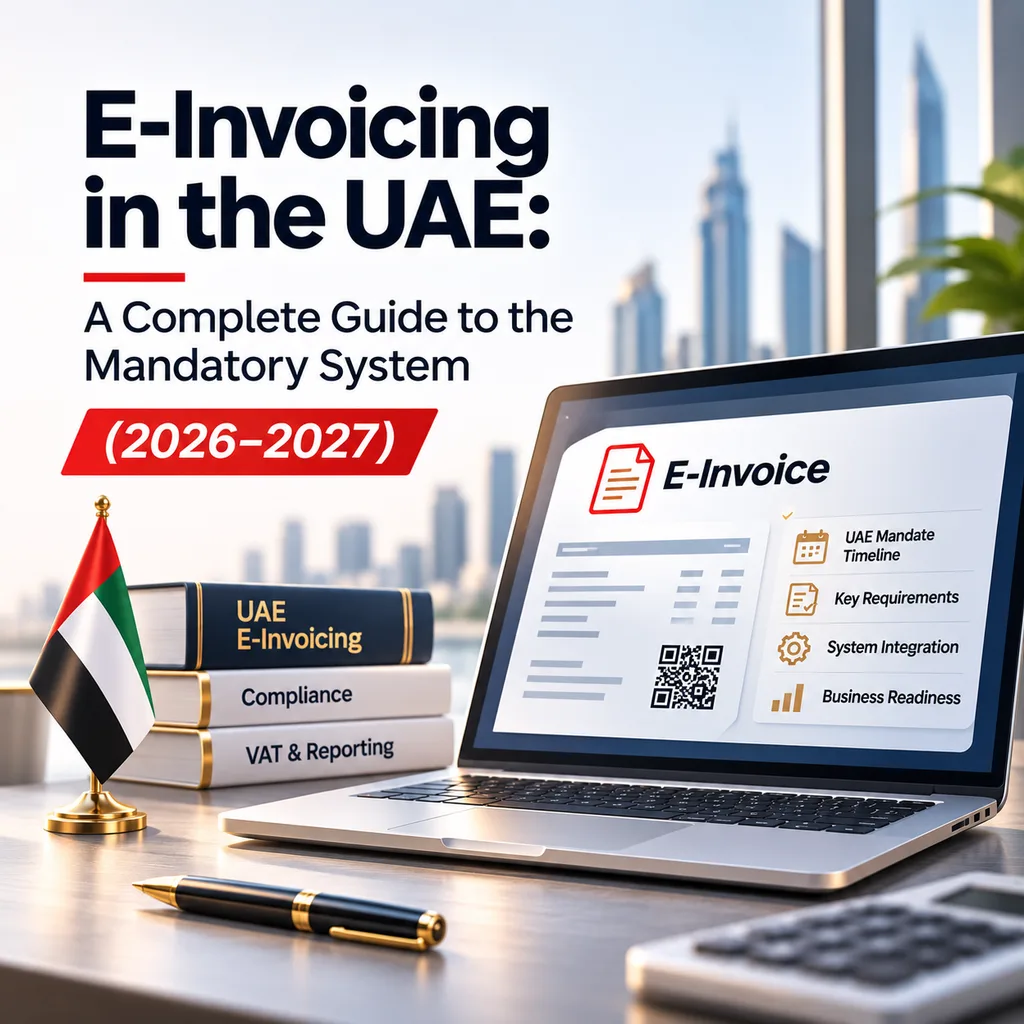
The United Arab Emirates is implementing a nationwide electronic invoicing (E-invoicing) system as a major step in its digital transformation and tax modernization efforts. Led by the Ministry of Finance (MoF) in coordination with the Federal Tax Authority (FTA), the system replaces unstructured invoices (such as PDFs, Word documents, images or emails) with structured electronic data that is issued, exchanged and reported automatically.
An E-invoice is a structured form of invoice data exchanged electronically between supplier and buyer and reported to the FTA. It uses the Peppol network with the UAE-specific PINT AE format (based on Open Peppol standards) under a 5-corner model involving Accredited Service Providers (ASPs).
Key Timeline
The rollout is phased:
| Category | Appointing ASP by | Mandatory go-live |
|---|---|---|
| Businesses with revenue ≥ AED 50 million | 30 October 2026 | 1 January 2027 |
| Businesses with revenue < AED 50 million | 31 March 2027 | 1 July 2027 |
| Government entities | 31 March 2027 | 1 October 2027 |
The ASP appointment deadline for larger businesses was extended from 31 July 2026 to 30 October 2026, however the 1st January 2027 go-live date remains unchanged. Revenue is based on the most recent accounting period
Who Must Comply?
The system applies to any person conducting business in the UAE for B2B and B2G transactions (including credit notes), regardless of VAT registration status.
Currently excluded or out of scope (subject to future decisions):
- Business-to-consumer (B2C) sales to individual consumers
- Certain sovereign government activities
- Specific exempt financial services
- Temporary 24-month exclusion (1 January 2027 to 31 December 2028) for transactions between members of the same VAT Tax Group (Ministerial Decision No. 197 of 2026)
Foreign businesses that issue UAE tax invoices are generally in scope for those invoices. Imports from abroad typically do not pass through the system.
How the System Works
Businesses must appoint one Accredited Service Provider (ASP) from the MoF’s official list. The ASP handles connection to the Peppol network, validation, exchange with the counterparty’s ASP and reporting to the FTA.
Key operational rules (as updated):
- Issue and transmit E-invoices/credit notes through the system within 14 business days of the transaction date (or earlier of transaction/payment receipt). VAT-registered businesses must also follow VAT Law timelines.
- Structured data only — unstructured formats do not qualify.
- Recent amendments (Ministerial Decision No. 197 of 2026, effective 1 October 2026) removed the strict in-country data storage requirement (records must still be retained for the statutory period under tax procedures law and be producible on FTA request) and eliminated mandatory system-failure notifications to the FTA.
Benefits
Countries that have implemented E-invoicing successfully report significant reductions in invoice processing costs (potentially up to around 66%), faster payments, fewer errors, improved cash flow visibility, stronger compliance and reduced fraud risk. For the UAE, it supports real-time tax reporting, digital economy goals, and easier cross-border trade via Peppol interoperability.
Penalties for non-compliance
Under Cabinet Decision No. 106 of 2025, penalties apply from a business go-live date. Common fines cited include AED 5,000 per month for failure to comply with E-invoicing obligations, plus potential per-invoice late fees (e.g., AED 100 per late e-invoice, often capped monthly). Exact application depends on the specific violation — businesses should monitor official FTA guidance.
Preparation Checklist
- 1Determine your revenue category and deadlines.
- 2Review the official MoF E- invoicing portal (mof.gov.ae) and do ASP registration.
- 3Select and appoint an ASP well ahead of your deadline (large businesses face the 30 October 2026 cutoff).
- 4Map current invoicing processes, ERP/accounting systems and data fields to the PINT AE requirements.
- 5Test integrations during the voluntary/pilot window where possible.
- 6Train finance, sales and IT teams, updating contracts and customer/supplier communications.
- 7Plan for credit notes, self-billing (if applicable) and record retention.
Frequently Asked Questions
1When does e-invoicing become mandatory in the UAE?
Mandatory implementation begins on 1 January 2027 for businesses with annual revenue of AED 50 million or more, on 1 July 2027 for businesses below that threshold, and on 1 October 2027 for government entities. A pilot and voluntary phase has been open since 1 July 2026.
2What is the deadline to appoint an Accredited Service Provider (ASP)?
Businesses with revenue of AED 50 million or more must appoint an ASP by 30 October 2026. Businesses below that threshold and government entities must appoint an ASP by 31 March 2027.
3What exactly is an e-invoice under the UAE rules?
An E-invoice is a structured electronic data file (PINT AE format) that is issued, transmitted and received in a machine-readable form and reported to the Federal Tax Authority. Ordinary PDFs, Word documents, scanned images or emails do not qualify as e-invoices.
4Are B2C (business-to-consumer) invoices required?
No. At present the mandate covers B2B and B2G transactions only. Sales to individual consumers are excluded unless the Minister decides otherwise in the future.
5Do I need to be VAT-registered to fall under the e-invoicing system?
No. The obligation applies to any person conducting business in the UAE for in-scope transactions, whether or not the person is registered for VAT.
6Can e-invoice data be stored outside the UAE?
Yes. Ministerial Decision No. 197 of 2026 removed the previous in-country storage requirement. Records must still be retained for the period required by the Tax Procedures Law and must be made available to the FTA upon request.
7Are transactions within the same VAT Tax Group subject to e-invoicing?
For a temporary period of 24 months starting 1 January 2027, business transactions between members of the same VAT Tax Groups are excluded from the e-invoicing requirements (Ministerial Decision No. 197 of 2026).
8What happens if I miss the implementation deadline?
Administrative penalties under Cabinet Decision No. 106 of 2025 apply from the relevant go-live date. These commonly include a monthly penalty of AED 5,000 for non-compliance, together with possible per-invoice late fees. Exact amounts depend on the nature of the breach.
9How many ASPs may a business appoint?
Each business appoints one Accredited Service Provider for the purpose of sending and receiving e-invoices under the system. The current list of accredited providers is published by the Ministry of Finance.
10Where can I find the official technical specifications and ASP list?
The Ministry of Finance e-Invoicing portal (mof.gov.ae) and the Federal Tax Authority website (tax.gov.ae) publish the guidelines, mandatory field requirements, PINT AE specifications and the register of Accredited Service Providers. These should be treated as authoritative sources.
Disclaimer. This document is provided for general informational purposes only and reflects publicly available information as of October 2026. It does not constitute legal, tax or professional advice. Requirements may be updated by the Ministry of Finance or the Federal Tax Authority.
Readers should verify the latest rules on the official portals and consult a qualified advisor before taking any action.

Author:
Mohamed Rila Sirajudeen Fazul Mohamed (Tax Agent)
Bazaar Accounting & Management Advisors LLC